Introduction
Modern education is no longer defined by textbooks, whiteboards, and standalone classroom equipment. As schools and universities continue their digital transformation, learning spaces are becoming increasingly connected, interactive, and technology-driven.
The concept of a smart classroom has emerged as a key part of this transformation. However, many people associate smart classrooms simply with replacing traditional teaching tools with digital devices such as interactive displays, projectors, cameras, and audio systems.
While these technologies are important, a truly smart classroom is about much more than hardware upgrades.
The real intelligence of a smart classroom lies in the ability to connect, control, automate, and manage classroom technologies through a unified platform. By integrating teaching devices, audiovisual systems, environmental controls, and management tools into a connected ecosystem, schools can improve teaching efficiency, simplify IT operations, and create more engaging learning experiences.
In this guide, we’ll explore what a smart classroom really is, how it differs from a traditional digital classroom, the technologies behind it, its key benefits, and practical considerations for building a future-ready learning environment.
A smart classroom is not defined by how many digital devices it contains, but by how intelligently those devices are connected, controlled, and managed.

What Is a Smart Classroom?
While the term “smart classroom” has become increasingly common in education, its meaning is often misunderstood.
For many schools, a smart classroom simply refers to a classroom equipped with digital teaching tools such as interactive displays, projectors, document cameras, microphones, and educational software. Although these technologies enhance teaching and learning, the presence of digital devices alone does not automatically create a smart learning environment.
To understand what truly makes a classroom “smart”, it is important to look beyond the hardware itself.
Smart Classroom Is More Than Digital Equipment
A classroom can be filled with advanced technology and still operate much like a traditional classroom.
Teachers may need to power on multiple devices individually, switch between different control systems during lessons, and troubleshoot technical issues before teaching can even begin. Meanwhile, IT staff often spend significant time maintaining equipment, managing classrooms separately, and responding to support requests across campus.
In this situation, technology has been digitized, but the classroom itself has not become truly intelligent.
A smart classroom is not defined by how many devices it contains, but by how intelligently those devices are connected, controlled, and managed.
The real value of a smart classroom lies in integrating teaching technologies, audiovisual systems, environmental controls, and management platforms into a unified ecosystem. Through centralized control, automation, and remote management, schools can simplify classroom operations, improve resource utilization, and create more seamless teaching experiences.
Digital Classroom vs Smart Classroom
| Digital Classroom | Smart Classroom |
| Focuses on upgrading teaching equipment | Focuses on optimizing teaching and management processes |
| Individual digital devices | Connected and integrated classroom ecosystem |
| Multiple independent control methods | Unified control platform |
| Manual operation of classroom devices | Automated classroom workflows |
| Limited visibility for administrators | Centralized monitoring and management |
| Classroom-level deployment | Campus-wide scalability |
A digital classroom improves the tools available for teaching.
A smart classroom improves how those tools work together.
By connecting classroom devices through a centralized platform, schools can move beyond isolated technology deployments and build learning environments that are easier to manage, more efficient to operate, and better aligned with future educational needs.
Key Characteristics of a Smart Classroom
A smart classroom is not defined by a single device or technology. Instead, it is built on a combination of interconnected systems that work together to create a more efficient, engaging, and manageable learning environment.
While implementations may vary between schools and universities, most successful smart classroom projects share several key characteristics.
Connected Learning Environment
In a smart classroom, teaching devices and systems are connected through a unified network infrastructure. Displays, projectors, audio systems, cameras, microphones, and classroom control devices can communicate with each other and operate as part of an integrated ecosystem.
This connectivity enables seamless collaboration, content sharing, and device coordination throughout the learning space.
Centralized Classroom Control
One of the most important characteristics of a smart classroom is centralized control.
Instead of managing multiple devices separately, teachers can operate classroom technologies through a single touch panel, mobile application, or web-based interface. Common classroom functions such as source switching, volume adjustment, display control, and environmental settings can be managed more efficiently from one place.
Intelligent Automation
Routine classroom operations can be automated to reduce manual intervention and improve efficiency.
For example, classroom devices can automatically power on before a scheduled lesson and shut down after class ends. Lighting, audio systems, and other equipment can respond to predefined scenarios, helping create a more seamless teaching experience.
Interactive Learning Experience
Smart classrooms encourage active participation rather than passive learning.
Interactive displays, wireless presentation tools, multimedia content, and collaborative technologies allow students to engage more deeply with lessons and participate more actively in classroom discussions and activities.
Remote Monitoring and Management
For IT administrators, managing dozens or hundreds of classrooms can be a complex task.
Smart classroom platforms provide centralized visibility into classroom operations, allowing administrators to monitor device status, perform remote troubleshooting, manage configurations, and respond to technical issues more efficiently.
Scalable Campus-wide Deployment
A smart classroom should not operate as an isolated technology island.
Modern solutions are designed to scale beyond individual classrooms, enabling centralized management across multiple classrooms, lecture halls, learning spaces, and even entire campuses through a unified management platform.

Why Are Smart Classrooms Important?
The growing adoption of smart classrooms is not simply the result of technological advancement. It is driven by the changing needs of modern education.
Today’s schools and universities are expected to deliver more engaging learning experiences, support hybrid teaching models, improve operational efficiency, and make better use of educational resources. Traditional classroom environments often struggle to meet these expectations, creating challenges for educators, students, and administrators alike.
Smart classrooms help educational institutions bridge this gap by combining technology, automation, and centralized management into a more connected and efficient learning environment.
Enhancing Student Engagement
Students today are digital natives who are accustomed to interactive and multimedia-rich experiences in their daily lives.
Smart classrooms enable educators to incorporate videos, interactive content, wireless collaboration, real-time feedback, and digital learning resources into lessons, helping create a more engaging and participatory learning experience.
By encouraging active involvement rather than passive observation, smart classrooms can improve student attention, collaboration, and knowledge retention.
Improving Teaching Efficiency
Technology should support teaching, not complicate it.
In many traditional classrooms, teachers spend valuable class time operating multiple devices, switching between systems, or troubleshooting technical issues.
Smart classrooms simplify classroom operations through centralized control and automation, allowing educators to focus more on teaching and less on technology management.
Simplifying Classroom and Campus Management
As educational institutions expand their digital infrastructure, managing classroom technology becomes increasingly complex.
A smart classroom solution enables schools to monitor device status, automate routine operations, and centrally manage multiple classrooms from a unified platform. This reduces administrative workload and helps IT teams maintain consistent classroom experiences across the campus.
Supporting Hybrid and Flexible Learning
Modern education is no longer limited to face-to-face instruction.
Hybrid learning, remote participation, lecture recording, and digital collaboration have become increasingly important in both K-12 and higher education environments.
Smart classrooms provide the technological foundation needed to support these flexible teaching models, helping institutions adapt to evolving educational requirements.
Maximizing Technology Investments
Schools invest significant resources in educational technology, yet many devices remain underutilized due to fragmented management and limited visibility.
Smart classroom platforms provide greater insight into device usage, classroom operations, and resource allocation, helping institutions maximize the return on their technology investments.
Building Future-ready Learning Environments
Educational technology continues to evolve rapidly. Institutions need infrastructure that can support future growth without requiring constant redesign or replacement.
By adopting smart classroom solutions based on centralized management, automation, and scalable technologies, schools can build learning environments that are prepared for future innovations and long-term digital transformation.
Key Technologies Behind Smart Classrooms
A smart classroom is built upon a combination of technologies that work together to create a connected and intelligent learning environment.
While interactive displays, projectors, and other teaching devices are often the most visible components, the real intelligence of a smart classroom lies in the underlying technologies that enable centralized control, automation, communication, and management.
Understanding these technologies can help educational institutions make better decisions when planning classroom upgrades and smart campus initiatives.
Classroom Control Systems
A classroom control system serves as the operational center of a smart classroom.
Instead of managing displays, projectors, audio systems, lighting, and other devices separately, teachers can control classroom technologies through a single interface. Common classroom activities such as switching presentation sources, adjusting volume, powering devices on or off, and activating teaching scenarios can be performed with a single touch.
For schools and universities, centralized classroom control not only improves teaching efficiency but also simplifies technology adoption for educators.
Classroom Automation
Automation is one of the key factors that distinguishes a smart classroom from a traditional digital classroom.
Routine tasks that would normally require manual operation can be executed automatically based on schedules, predefined scenarios, or user actions.
For example, classroom devices can automatically start before a lesson begins, displays can switch to the appropriate input source, and equipment can shut down after class ends to reduce energy consumption and unnecessary maintenance.
Automation helps create a smoother classroom experience while reducing operational workload.
AV-over-IP Technology
Modern classrooms rely heavily on audio and video content for teaching and collaboration.
AV-over-IP technology enables audio and video signals to be distributed over standard network infrastructure rather than dedicated cabling systems. This allows schools to share content between classrooms, lecture halls, and other learning spaces more efficiently.
Compared with traditional AV systems, AV-over-IP solutions offer greater flexibility, scalability, and centralized management capabilities, making them an important foundation for large-scale smart classroom deployments.
Device Management Platforms
As educational institutions deploy more classroom technologies, device management becomes increasingly important.
A centralized device management platform allows administrators to monitor equipment status, perform remote maintenance, receive system alerts, and manage classroom devices across multiple locations from a single dashboard.
This visibility helps IT teams reduce downtime, improve operational efficiency, and maintain consistent classroom performance throughout the campus.
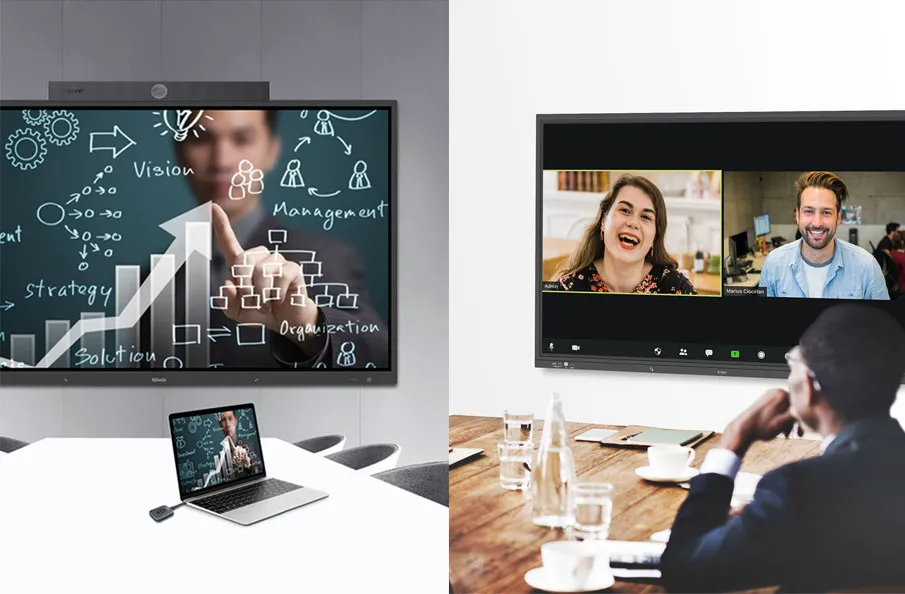
Wireless Presentation and Collaboration
Modern learning environments encourage active participation and collaboration.
Wireless presentation technologies allow teachers and students to share content directly from laptops, tablets, and mobile devices without requiring physical cable connections.
These solutions support more flexible teaching styles and help facilitate collaborative learning experiences in both traditional and hybrid classrooms.
Lecture Capture and Hybrid Learning Technologies
The growing demand for flexible learning has increased the importance of lecture capture and hybrid learning solutions.
By integrating cameras, microphones, recording systems, and collaboration platforms, schools can extend classroom experiences beyond physical spaces. Lessons can be recorded for future review, streamed to remote participants, or shared with students who are unable to attend in person.
These technologies help educational institutions support a broader range of learning models while improving accessibility and knowledge retention.
Centralized Campus Management
The most advanced smart classroom deployments extend beyond individual classrooms.
Through centralized management platforms, schools can oversee multiple classrooms, lecture halls, training rooms, and campus facilities from a unified system.
Administrators gain greater visibility into classroom operations, resource utilization, and technology performance, enabling smarter decision-making and more efficient campus management.
Ultimately, the goal of these technologies is not simply to introduce more devices into the classroom, but to create an intelligent ecosystem where teaching spaces, technologies, and management systems work together seamlessly.

Core Components of a Smart Classroom
While every educational institution has different teaching requirements, most smart classroom deployments are built upon several core components that work together to create a connected, interactive, and manageable learning environment.
These components can be grouped into three layers: teaching technologies, control and management systems, and supporting infrastructure.
Interactive Display Systems
Interactive displays serve as the primary visual and collaboration tool in many modern classrooms.
Compared with traditional whiteboards and projectors, interactive displays enable educators to present multimedia content, annotate directly on screen, access digital learning resources, and facilitate more interactive classroom discussions.
As one of the most visible technologies in a smart classroom, interactive displays help create a more engaging and collaborative learning experience.
Audio Reinforcement Systems
Clear communication is essential for effective teaching.
Audio systems typically include microphones, speakers, amplifiers, and audio processors that ensure every student can clearly hear classroom instruction regardless of classroom size.
In larger classrooms and lecture environments, professional audio systems help improve speech intelligibility and reduce communication barriers.
Cameras and Lecture Capture Systems
Cameras and lecture capture technologies allow educational institutions to record, stream, and archive classroom activities.
These systems support hybrid learning, distance education, content sharing, and lesson review, making learning more accessible and flexible for students.
As blended learning becomes increasingly common, lecture capture has become an important component of modern smart classroom environments.
Wireless Presentation and Collaboration Tools
Modern classrooms encourage collaboration and active participation.
Wireless presentation systems allow teachers and students to share content directly from laptops, tablets, and mobile devices without requiring cable connections.
This flexibility supports group activities, collaborative learning, and more dynamic classroom interactions.
Classroom Control Panels
A classroom control panel acts as the central interface for managing classroom technologies.
Instead of operating multiple devices independently, teachers can control displays, projectors, audio systems, cameras, lighting, and other classroom equipment from a single interface.
By simplifying device operation, classroom control systems help reduce technical distractions and improve teaching efficiency.
Environmental Control Systems
A truly smart classroom extends beyond teaching technologies.
Lighting, curtains, air conditioning, and other environmental systems can be integrated into the classroom control platform to improve comfort, energy efficiency, and operational consistency.
Automated environmental control also helps create more suitable learning conditions for different teaching activities.
Network Infrastructure
Reliable network connectivity forms the foundation of every smart classroom.
Network switches, wired networks, and wireless connectivity enable communication between classroom devices, management platforms, and campus systems.
Without a stable network infrastructure, centralized management and classroom automation cannot be fully realized.
Centralized Management Platform
The centralized management platform is what transforms a collection of classroom devices into a truly smart classroom ecosystem.
Through a unified platform, administrators can monitor classroom status, manage devices remotely, schedule automated operations, receive alerts, and analyze system performance across multiple classrooms and campuses.
This management layer enables schools to move beyond device deployment and achieve intelligent classroom operations at scale.
| Component | Primary Function |
| Interactive Display | Content Presentation & Collaboration |
| Audio System | Voice Reinforcement |
| Camera & Lecture Capture | Recording & Hybrid Learning |
| Wireless Presentation | Content Sharing |
| Control Panel | Centralized Device Control |
| Environmental Control | Comfort & Energy Management |
| Network Infrastructure | Device Connectivity |
| Management Platform | Monitoring & Administration |
Benefits of Smart Classroom Technology
The value of a smart classroom extends far beyond technology deployment. When implemented effectively, smart classroom solutions can improve teaching experiences, simplify operations, optimize resource utilization, and support long-term digital transformation goals.
The benefits are experienced by every stakeholder within an educational institution—from teachers and students to IT teams and school administrators.
Benefits for Teachers
Teaching should focus on delivering knowledge and engaging students, not managing technology.
Smart classroom solutions simplify classroom operations by integrating multiple devices into a single control platform. Teachers can launch lessons, switch content sources, control classroom equipment, and access teaching resources more efficiently.
This reduces classroom disruptions and allows educators to spend more time interacting with students.
Key benefits include:
- Simplified classroom technology operation
- Reduced setup and troubleshooting time
- Faster access to teaching resources
- Improved lesson delivery efficiency
- More engaging classroom experiences
Benefits for Students
Technology can help create a more interactive and collaborative learning environment.
Smart classrooms support multimedia teaching, interactive participation, content sharing, and flexible learning opportunities that encourage students to become active participants in the learning process.
Students benefit from:
- Greater classroom engagement
- Enhanced collaboration opportunities
- Improved access to learning resources
- More personalized learning experiences
- Better support for hybrid and remote learning
Benefits for IT Administrators
Managing classroom technologies across multiple buildings and campuses can be a significant challenge.
Smart classroom platforms provide centralized monitoring, remote troubleshooting, automated scheduling, and device management capabilities that help IT teams operate more efficiently.
Rather than maintaining classrooms individually, administrators gain visibility and control across the entire campus infrastructure.
Key benefits include:
- Centralized device monitoring
- Remote management and maintenance
- Faster issue resolution
- Reduced operational workload
- Improved technology standardization
Benefits for School Management
School leaders are increasingly expected to maximize educational outcomes while improving operational efficiency.
Smart classroom solutions provide valuable insights into classroom utilization, technology performance, and resource allocation. Centralized management and automation also help reduce operational costs and improve long-term technology planning.
Benefits for educational institutions include:
- Better utilization of technology investments
- Improved operational efficiency
- Enhanced campus-wide visibility
- More scalable technology deployment
- Stronger support for digital transformation initiatives
Energy Efficiency and Sustainability
Many educational institutions face increasing pressure to reduce energy consumption and improve sustainability.
Through intelligent scheduling and automated device control, smart classrooms can automatically power equipment on and off based on classroom usage, reducing unnecessary energy consumption and extending equipment lifespan.
This contributes to both environmental sustainability and lower operating costs.
Building a Future-ready Campus
Educational technology continues to evolve rapidly, and institutions need infrastructure that can adapt to changing requirements.
Smart classroom solutions provide a scalable foundation that supports future technologies, new teaching models, and campus expansion initiatives. By investing in connected and manageable learning environments today, schools can better prepare for tomorrow’s educational challenges.
How to Build a Smart Classroom
Building a smart classroom is not simply a matter of purchasing new equipment. Successful implementations require careful planning, clear educational objectives, and a technology strategy that supports both teaching and long-term management requirements.
Rather than focusing solely on hardware upgrades, schools should consider how classroom technologies, management systems, and operational processes work together to create a connected learning environment.
The following framework can help educational institutions plan and implement a successful smart classroom project.
Step 1: Define Educational and Operational Goals
Every smart classroom project should begin with clearly defined objectives.
Different institutions may have different priorities. Some schools focus on improving classroom interaction, while others aim to support hybrid learning, simplify classroom management, or enable campus-wide device control.
Before selecting technologies, schools should identify:
- Teaching and learning requirements
- Classroom usage scenarios
- IT management objectives
- Future expansion plans
- Budget and deployment priorities
A clear understanding of project goals helps ensure that technology investments align with long-term educational strategies.
Step 2: Assess Existing Classroom Infrastructure
Before introducing new technologies, institutions should evaluate their current classroom environment.
This assessment typically includes:
- Existing displays and projectors
- Audio systems
- Network infrastructure
- Power availability
- Classroom layouts
- Environmental control systems
Understanding the current infrastructure helps schools identify which systems can be integrated and which components may require upgrades.
Step 3: Select the Right Classroom Technologies
A modern smart classroom typically combines multiple technologies that support teaching, collaboration, automation, and management.
Depending on educational requirements, key technologies may include:
- Interactive displays
- Audio reinforcement systems
- Wireless presentation solutions
- Lecture capture systems
- Classroom control systems
- Environmental control systems
- Device management platforms
Rather than selecting products individually, schools should prioritize technologies that can operate as part of an integrated ecosystem.
Step 4: Establish a Unified Control and Automation System
This is where many classroom modernization projects fall short.
Simply adding more devices to a classroom does not automatically create a smart classroom.
A truly smart classroom requires a centralized control layer that allows technologies to work together seamlessly.
Through a unified control system, teachers can:
- Power classroom devices on and off
- Switch content sources
- Adjust audio settings
- Control classroom environments
- Launch predefined teaching scenarios
Automation can further simplify operations by scheduling classroom activities and reducing repetitive manual tasks.
Step 5: Enable Centralized Management
As the number of classrooms increases, centralized management becomes increasingly important.
A management platform enables administrators to:
- Monitor classroom status remotely
- Manage devices across campus
- Schedule automated operations
- Receive system alerts
- Analyze classroom usage data
This centralized approach significantly reduces IT workload and improves operational efficiency.
Step 6: Plan for Future Scalability
Educational technology requirements continue to evolve.
When designing a smart classroom, schools should consider how the solution will support future classroom upgrades, additional learning spaces, hybrid learning initiatives, and campus-wide expansion.
Scalable architectures help protect technology investments and reduce future deployment costs.
Step 7: Train Users and Establish Best Practices
Technology is most effective when users feel confident using it.
Teachers, IT administrators, and support staff should receive appropriate training to ensure that classroom technologies are used effectively and consistently.
Establishing clear operational procedures and support processes can help maximize the long-term value of smart classroom investments.
A Smart Classroom Is More Than a Technology Project
Many institutions view smart classroom initiatives primarily as equipment procurement projects. However, the most successful deployments focus on improving teaching experiences, operational efficiency, and long-term manageability.
By combining classroom technologies with centralized control, automation, and management capabilities, schools can create learning environments that are not only digitally equipped, but truly intelligent.

Looking for a detailed implementation framework? Read our complete guide on How to Build a Smart Classroom.
Smart Classroom Challenges and How to Overcome Them
While smart classrooms offer significant educational and operational benefits, successful implementation requires careful planning and execution.
Many schools encounter challenges related to budget, technology integration, user adoption, and long-term management. Understanding these potential obstacles can help institutions make more informed decisions and avoid common implementation pitfalls.
Challenge 1: Focusing on Devices Instead of System Integration
One of the most common misconceptions is that a smart classroom can be created simply by purchasing more advanced teaching equipment.
Many schools invest in interactive displays, projectors, cameras, and audio systems, only to discover that managing multiple standalone devices creates new operational complexities.
Without integration, teachers may still need to control different systems separately, while IT teams continue managing classrooms individually.
How to Overcome It
Instead of selecting technologies as independent products, institutions should focus on building an integrated ecosystem where devices, control systems, and management platforms work together.
A unified control and management architecture helps maximize the value of technology investments while improving usability and scalability.
Challenge 2: Managing Multiple Classrooms Efficiently
As smart classroom deployments expand across campuses, managing dozens or even hundreds of classrooms can become increasingly difficult.
Administrators often struggle with:
- Device monitoring
- Software updates
- Technical support requests
- Equipment maintenance
- Classroom status visibility
Managing classrooms individually quickly becomes unsustainable.
How to Overcome It
Implement a centralized management platform that enables remote monitoring, device management, scheduling, and troubleshooting across all learning spaces.
Centralized visibility significantly reduces IT workload and improves operational efficiency.
Challenge 3: Technology Adoption by Teachers
Even the most advanced classroom technologies deliver little value if teachers are uncomfortable using them.
Complex control systems and inconsistent classroom setups can create frustration and reduce technology adoption.
How to Overcome It
Prioritize simplicity and consistency.
Classroom technologies should be easy to operate, with intuitive interfaces and standardized user experiences across classrooms.
Training programs and ongoing support can also help educators gain confidence and maximize the benefits of classroom technology.
Challenge 4: Limited IT Resources
Many educational institutions operate with small IT teams that are responsible for supporting a large number of classrooms and devices.
As technology deployments grow, maintenance demands often increase.
How to Overcome It
Automation and remote management capabilities can significantly reduce administrative workload.
Features such as:
- Remote diagnostics
- Device health monitoring
- Automated scheduling
- Centralized configuration
allow IT teams to support more classrooms with fewer resources.
Challenge 5: Budget Constraints
Budget limitations remain a key concern for many schools.
Large-scale classroom modernization projects can appear costly, particularly when institutions focus solely on hardware procurement.
How to Overcome It
Develop a phased implementation strategy.
Schools can begin with priority classrooms and gradually expand deployment over time.
It is also important to evaluate total cost of ownership rather than focusing only on initial equipment costs. Centralized management and automation often reduce long-term operational expenses and improve return on investment.
Challenge 6: Future Scalability
Educational technology requirements continue to evolve.
A solution that meets today’s needs may struggle to support future classrooms, hybrid learning initiatives, or campus expansion projects.
How to Overcome It
Choose open, scalable solutions that can integrate with existing infrastructure and accommodate future growth.
A scalable architecture helps protect technology investments while supporting long-term digital transformation goals.
The Key to Long-Term Success
Many smart classroom projects focus primarily on technology procurement. However, the most successful deployments take a broader view, considering not only what technologies will be installed, but also how those technologies will be controlled, managed, maintained, and expanded over time.
By prioritizing integration, centralized management, automation, and scalability, schools can create smart classroom environments that continue delivering value long after the initial deployment is complete.
Smart Classroom vs Traditional Classroom
Traditional classrooms have supported education for decades, but the rapid advancement of digital learning technologies has changed how educational spaces are designed and managed.
While traditional classrooms primarily focus on delivering instruction, smart classrooms create connected learning environments that support interactive teaching, centralized management, and scalable campus operations.
The difference is not simply the presence of technology—it is how technology is integrated into the teaching and management process.
Comparison at a Glance
| Feature | Traditional Classroom | Smart Classroom |
| Teaching Tools | Whiteboard, projector, standalone devices | Integrated digital learning technologies |
| Device Operation | Individual manual control | Centralized control platform |
| Classroom Management | Managed separately | Centralized campus-wide management |
| Learning Experience | Primarily teacher-centered | Interactive and collaborative |
| Content Sharing | Limited and local | Digital and wireless |
| Device Monitoring | Manual inspection | Real-time monitoring |
| Classroom Automation | Minimal | Automated workflows |
| Hybrid Learning Support | Limited | Built-in support |
| Resource Utilization | Difficult to track | Data-driven optimization |
| Scalability | Classroom-by-classroom deployment | Campus-wide scalability |
Traditional Classrooms Focus on Teaching Delivery
In a traditional classroom, technology is often deployed as standalone tools.
Teachers may need to operate projectors, audio systems, and other devices separately. Classroom resources are typically managed individually, making maintenance and support more time-consuming for IT teams.
While this approach can effectively support instruction, it becomes increasingly difficult to manage as schools expand their technology infrastructure.
Smart Classrooms Focus on Connected Learning and Intelligent Management
Smart classrooms integrate teaching technologies, classroom control systems, automation, and management platforms into a unified ecosystem.
Teachers gain a simpler and more consistent teaching experience, while administrators benefit from centralized visibility and control across multiple learning spaces.
Rather than managing individual devices, schools can manage entire classroom environments more efficiently.
The Evolution of Educational Spaces
For many institutions, the transition from traditional classrooms to smart classrooms is not simply a technology upgrade.
It represents a shift from isolated devices and manual operations toward connected, data-driven, and scalable learning environments.
The goal is not to replace teaching with technology, but to use technology to create more engaging learning experiences, simplify classroom operations, and support the future of education.
Why Choose Q-NEX Smart Classroom Solution
Educational institutions today need more than standalone classroom technologies. They need solutions that simplify teaching, reduce operational complexity, and support long-term digital transformation initiatives.
Q-NEX Smart Classroom Solution is designed to help schools move beyond device deployment and build truly connected, manageable, and scalable learning environments.
Unlike conventional classroom technology solutions that focus primarily on individual devices, Q-NEX integrates classroom control, automation, device management, and campus-wide administration into a unified platform.
Unified Classroom Control
Control displays, projectors, audio systems, lighting, air conditioning, and other classroom devices from a single interface.
Centralized Device Management
Monitor and manage classrooms remotely through a centralized platform, reducing IT workload and improving operational efficiency.
Intelligent Automation
Automate routine classroom operations such as device startup, shutdown, scheduling, and environmental control.
Scalable Smart Campus Architecture
Deploy solutions across individual classrooms, lecture halls, collaborative learning spaces, and entire campuses through a unified management framework.
Flexible Integration
Integrate with existing classroom technologies and educational infrastructure without requiring a complete system replacement.
Future-ready Design
Support evolving teaching models, hybrid learning initiatives, and future campus expansion through a scalable architecture.
Q-NEX Smart Classroom Solution Supports
- Smart Classrooms
- Lecture Capture Classrooms
- Lecture Halls
- Collaborative Learning Spaces
- Divisible Classrooms
- Campus-wide AV Broadcast Systems
Whether institutions are upgrading a single classroom or building a campus-wide smart learning ecosystem, Q-NEX provides the technologies and management capabilities needed to support efficient, connected, and future-ready educational environments.
Frequently Asked Questions About Smart Classrooms
What is a smart classroom?
A smart classroom is a technology-enabled learning environment that integrates teaching devices, classroom control systems, automation, and management platforms to create more interactive, efficient, and connected learning experiences.
Unlike traditional digital classrooms that focus primarily on hardware upgrades, smart classrooms emphasize device integration, centralized management, and intelligent automation.
What is the difference between a digital classroom and a smart classroom?
A digital classroom typically focuses on introducing digital teaching equipment such as interactive displays, projectors, and educational software.
A smart classroom goes further by connecting these technologies through centralized control, automation, and management systems, enabling more efficient classroom operation and campus-wide administration.
What technologies are commonly used in a smart classroom?
A typical smart classroom may include:
- Interactive displays
- Audio systems
- Microphones and speakers
- Cameras and lecture capture systems
- Wireless presentation solutions
- Classroom control systems
- Environmental control systems
- Centralized management platforms
The exact configuration depends on the institution’s teaching and operational requirements.
What are the benefits of a smart classroom?
Smart classrooms can provide benefits for teachers, students, IT administrators, and school management teams, including:
- Improved student engagement
- More efficient teaching workflows
- Simplified classroom management
- Reduced IT workload
- Better resource utilization
- Support for hybrid learning
- Enhanced campus-wide visibility
How does a smart classroom improve teaching efficiency?
Smart classrooms simplify classroom technology operation by providing a centralized control interface for displays, audio systems, cameras, and other devices.
Teachers spend less time managing equipment and more time focusing on instruction, classroom interaction, and student engagement.
Can smart classrooms support hybrid learning?
Yes.
Smart classrooms often integrate cameras, microphones, lecture capture systems, and collaboration platforms that allow lessons to be recorded, streamed, or shared with remote participants.
These technologies help schools support in-person, remote, and hybrid learning models.
How can schools manage multiple smart classrooms efficiently?
The most effective approach is through a centralized management platform.
Administrators can remotely monitor device status, perform maintenance, automate classroom operations, receive alerts, and manage multiple classrooms from a single dashboard, significantly reducing operational complexity.
Are smart classrooms suitable for universities and K-12 schools?
Yes.
Smart classroom solutions can be adapted to various educational environments, including:
- Primary schools
- Secondary schools
- Universities
- Vocational institutions
- Training centers
The technologies and deployment scale can be customized according to educational needs and budget requirements.
How much does it cost to build a smart classroom?
The cost of a smart classroom varies depending on classroom size, technology requirements, infrastructure conditions, and management objectives.
A basic deployment may focus on interactive teaching technologies, while advanced smart classroom projects may include centralized control, automation, lecture capture, and campus-wide management capabilities.
Schools should evaluate both initial investment costs and long-term operational benefits when planning a project.
What should schools consider before implementing a smart classroom solution?
Before implementation, schools should evaluate:
- Educational goals
- Classroom usage scenarios
- Existing infrastructure
- Network readiness
- Device integration requirements
- IT management capabilities
- Future expansion plans
Successful projects focus not only on technology deployment but also on long-term usability, scalability, and management efficiency.
Ready to Build a Smarter Learning Environment?
A smart classroom is more than a collection of digital devices. It is a connected ecosystem that combines teaching technologies, centralized control, automation, and management into a unified learning environment.
Whether you’re planning a classroom upgrade, implementing a lecture capture system, or building a campus-wide smart learning infrastructure, Q-NEX can help you design a solution that supports both today’s teaching needs and tomorrow’s educational goals.
For more information on how the QNEX Smart Classroom can revolutionize your teaching experience, please visit our website or contact our professional team for assistance.
Here are some other articles that we think might interest you:
Why Smart Classroom Solutions Are Shaping the Future of Education?